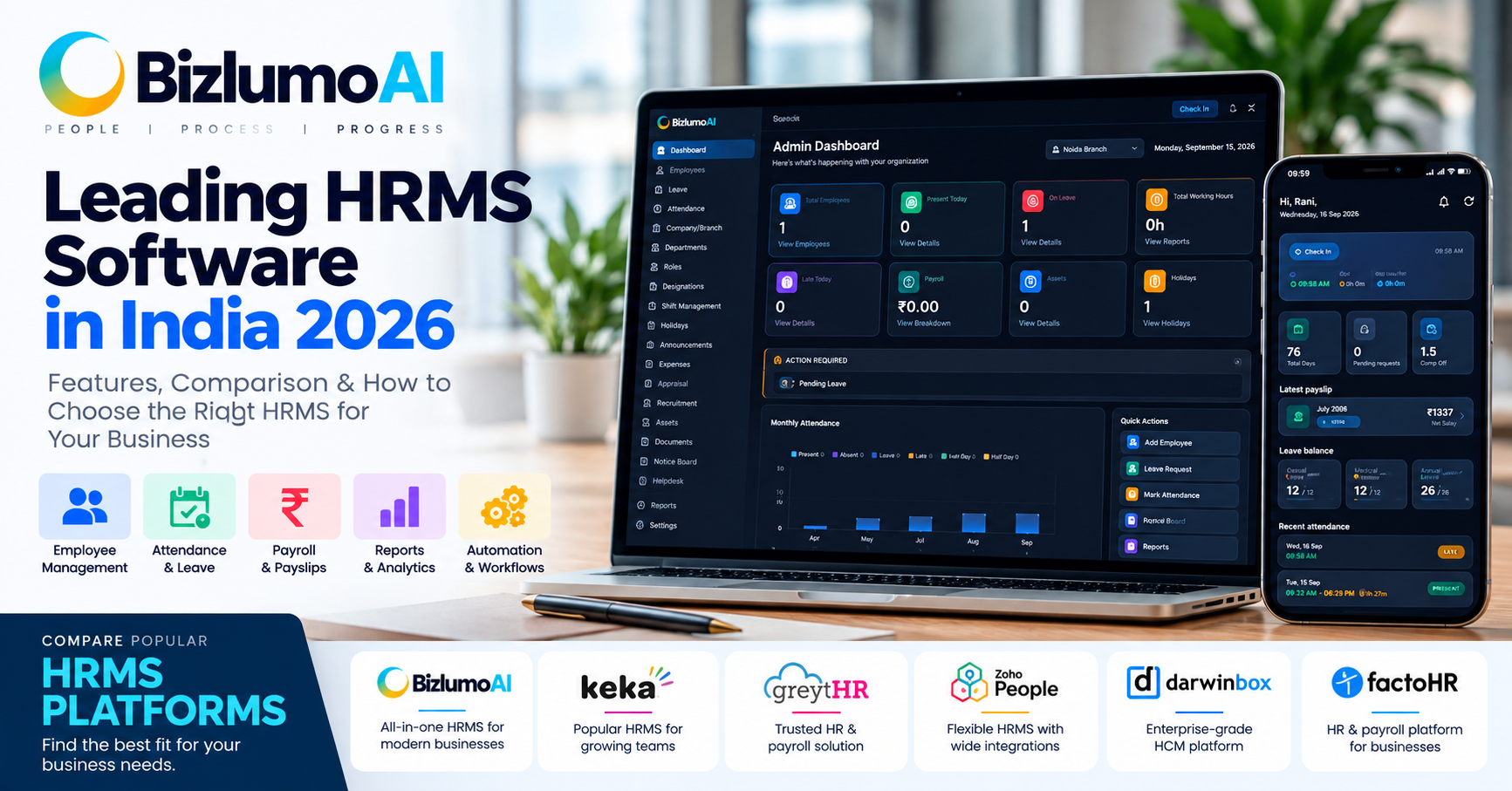
Choosing the right Human Resource Management System (HRMS) is an important decision for businesses looking to streamline employee management, attendance, payroll, and HR operations.
With several HRMS platforms available in India, businesses can choose from payroll-focused software, integrated HR management platforms, mobile-first attendance solutions, and enterprise-grade human capital management systems.
But which HRMS is right for your business?
The answer depends on your employee strength, operational requirements, budget, attendance policies, payroll processes, and plans for growth.
In this guide, we compare leading HRMS software in India, including greytHR, Keka, Zoho People, Darwinbox, factoHR, and BizlumoAI HRMS, to help businesses understand their features and evaluate suitable options.
What Is HRMS Software?
An HRMS, or Human Resource Management System, is software that helps organizations manage employee information and automate human resource processes through a centralized platform.
Instead of managing employee records, attendance registers, leave requests, salary calculations, and reports across separate spreadsheets, businesses can connect these activities through an integrated HR system.
A modern HRMS may include:
- Employee database and employee lifecycle management
- Attendance and shift management
- Leave and holiday management
- Payroll processing and payslips
- Employee self-service
- Recruitment and onboarding
- Performance and appraisal management
- Expense and reimbursement management
- HR analytics and reporting
- Mobile applications and location-based attendance
The features available depend on the vendor, subscription plan, and modules selected.
Why Businesses Are Adopting HRMS Software in 2026
As organizations grow, managing HR activities manually becomes increasingly complicated.
An HR team may need to track attendance, calculate payable working days, verify leave balances, prepare payroll, maintain employee documents, and respond to employee queries every month.
These activities can become difficult when information is distributed across multiple systems.
HRMS software helps bring these processes into a structured digital workflow.
1. Reduced manual administration
Routine activities such as employee data management, leave tracking, attendance processing, and report generation can be handled through centralized software.
2. More organized attendance and payroll
Connecting attendance and leave information with payroll workflows can reduce repeated data entry and help HR teams review salary calculations more efficiently.
3. Better employee experience
Employee self-service features allow employees to access payslips, view attendance, submit leave requests, and check request status without depending entirely on HR personnel.
4. Workforce visibility
Dashboards and reports provide management with access to relevant employee, attendance, leave, and payroll information.
Leading HRMS Software in India: Quick Comparison
The following platforms represent different approaches to HR management, from payroll-oriented solutions to enterprise human capital management.
This is a feature and use-case comparison, not an overall ranking. Product capabilities, integrations, and plan inclusions can change, so businesses should confirm the latest specifications with each vendor before purchasing.
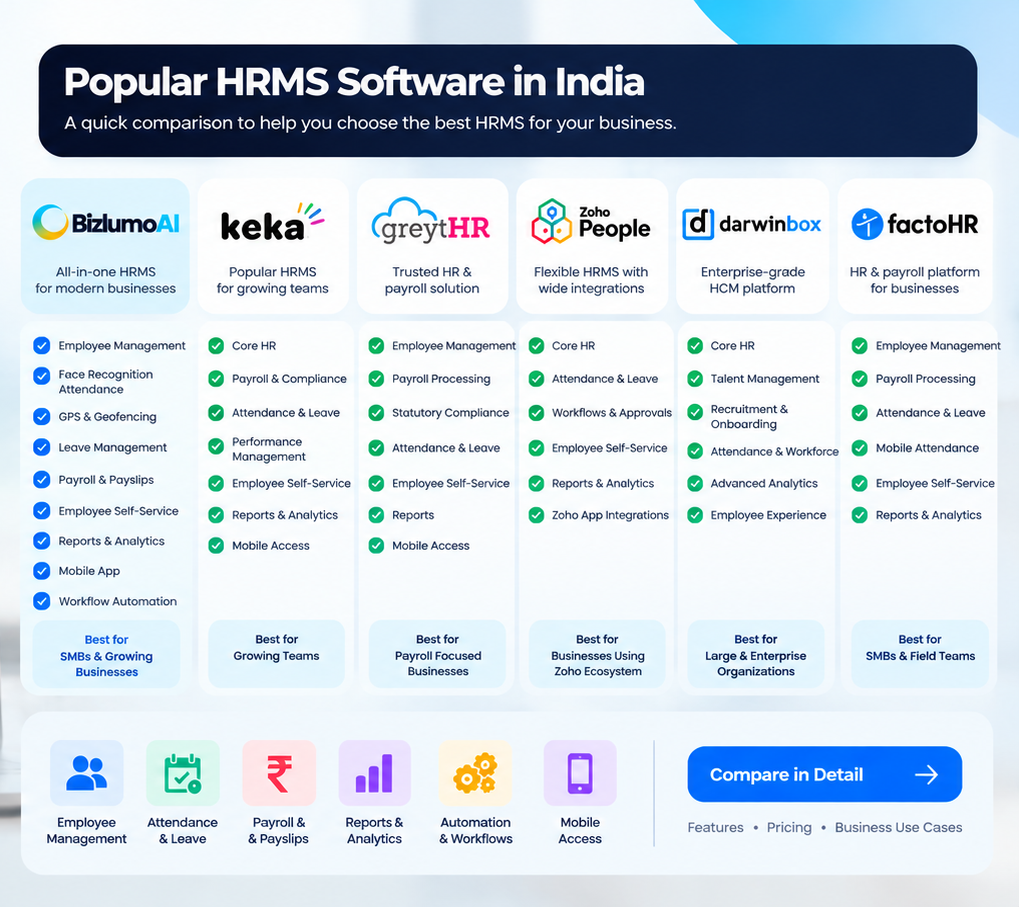
| HRMS Software | General Product Focus | Key Areas to Evaluate |
|---|---|---|
| greytHR | HR and payroll management | Payroll processing, statutory workflows, attendance, employee lifecycle |
| Keka HR | Integrated HR and payroll | Core HR, payroll, performance, attendance, employee experience |
| Zoho People | Cloud-based HR management | Employee records, leave, attendance, workflows, Zoho integrations |
| Darwinbox | Enterprise HCM | Talent management, workforce management, analytics, employee lifecycle |
| factoHR | HR and payroll automation | Attendance, payroll, employee self-service, mobile workforce |
| BizlumoAI HRMS | Integrated HR operations for businesses | AI face recognition, GPS attendance, leave, payroll, employee self-service |
Sources: Vendor comparison and product guides from greytHR, factoHR and AppAdvisor, updated during 2026. Features and packaging should be confirmed directly with the respective vendors.
1. greytHR
greytHR provides HR and payroll software covering employee management, payroll processing, leave, attendance, and related HR workflows.
The platform is particularly relevant to businesses evaluating payroll and employee administration in the Indian regulatory environment.
Key features to evaluate
- Payroll processing and statutory reporting
- Employee records and lifecycle management
- Leave and attendance management
- Employee self-service
- HR reports and mobile access
Suitable business requirements
Businesses looking for a structured HR and payroll platform can evaluate greytHR based on payroll complexity, employee strength, attendance requirements, and the modules included in the selected plan.
Before selecting a subscription, confirm payroll coverage, implementation requirements, reporting capabilities, and the total cost for your workforce.
Website: https://www.greythr.com/
2. Keka HR
Keka offers an integrated HR and payroll platform with capabilities spanning employee management, attendance, payroll, performance management, and employee experience.
Its product scope makes it relevant to businesses looking to connect core HR processes with workforce and performance management.
Key features to evaluate
- Core HR and employee lifecycle
- Payroll and attendance
- Performance and appraisal management
- Employee self-service
- Reporting and workflow automation
Suitable business requirements
Organizations evaluating Keka should consider the complexity of their payroll, performance review processes, workforce structure, and required integrations.
Businesses should also confirm which modules are included in their proposed plan and whether implementation or additional functionality carries separate charges.
Website: https://www.keka.com/
3. Zoho People
Zoho People is a cloud-based HR management platform within the Zoho business software ecosystem.
It provides HR capabilities such as employee information management, attendance, leave, workflows, and employee self-service, with integrations across Zoho applications.
Key features to evaluate
- Employee database and HR administration
- Leave and attendance tracking
- Time and shift management
- Employee self-service
- Workflow automation and integrations
Suitable business requirements
Zoho People can be evaluated by organizations already using Zoho applications or those seeking a modular cloud-based HR platform.
One important consideration for Indian businesses is the distinction between HR management and statutory payroll functionality. Confirm whether Zoho Payroll or another payroll integration is required for your specific requirements.
Website: https://www.zoho.com/people/
4. Darwinbox
Darwinbox is an enterprise-oriented human capital management platform designed to support a broad range of HR processes across the employee lifecycle.
Its platform covers areas such as core HR, talent acquisition, talent management, workforce management, employee experience, and analytics.
Key features to evaluate
- Core HR and employee lifecycle management
- Recruitment and onboarding
- Performance and talent management
- Workforce management
- Analytics and enterprise integrations
Suitable business requirements
Darwinbox is relevant for organizations evaluating enterprise HR technology, particularly where multiple business units, complex workforce structures, talent processes, and integrations are involved.
Businesses should assess implementation scope, configuration requirements, integration capabilities, and the commercial proposal for their specific workforce.
Website: https://darwinbox.com/
5. factoHR
factoHR provides HR and payroll software with capabilities across employee management, attendance, payroll, leave, and workforce administration.
Its product scope includes mobile and attendance-related functionality that businesses with distributed or field-based employees may want to evaluate.
Key features to evaluate
- Employee management and HR administration
- Payroll processing
- Attendance and leave management
- Mobile attendance and location-based features
- Employee self-service and reports
Suitable business requirements
factoHR can be evaluated by organizations looking to connect HR administration, attendance, and payroll, including businesses with multiple locations or field teams.
The suitability of specific attendance methods, payroll configurations, and integrations should be validated during a product demonstration.
Website: https://factohr.com/
6. BizlumoAI HRMS
BizlumoAI HRMS is designed to bring employee management, attendance, leave, payroll, and HR reporting together in one platform.
It focuses on helping businesses move away from fragmented HR processes and manage workforce operations through a centralized web and mobile system.
Key features
AI-powered face recognition attendance
Face recognition attendance supports employee identity verification during attendance recording, with anti-spoofing protection designed to help address attempts to use unauthorized images or presentation methods.
GPS-based attendance and geofencing
Location-based attendance capabilities can help businesses apply attendance rules for office-based and field employees, subject to the organization's configuration and permissions.
Attendance and leave management
HR teams can manage attendance records, leave requests, leave balances, and attendance reporting within the platform.
Payroll automation and payslips
Payroll functionality supports salary processing and payslip management, helping businesses organize recurring payroll activities.
Employee self-service
Employees can use the mobile application to access relevant HR information, check attendance, review leave balances, submit requests, and view payslip information according to their access permissions.
Reports and workforce visibility
The platform includes attendance reports, muster roll reporting, employee information, and administrative dashboards to support HR and management workflows.
Who should evaluate BizlumoAI HRMS?
BizlumoAI HRMS can be evaluated by startups, small and medium-sized businesses, and organizations looking for an integrated HR system with mobile attendance, leave, payroll, and employee management capabilities.
It may be particularly relevant to businesses that want to evaluate face recognition attendance, GPS-based attendance, and centralized employee self-service as part of their HR workflow.
Businesses should confirm the exact modules, payroll requirements, integration needs, employee limits, and implementation scope applicable to their requirements.
Website: https://bizlumoai.com/
HRMS Feature Comparison: What Should You Look For?
A software comparison should go beyond the number of features listed on a vendor's website.
The following table outlines key capabilities businesses can use when evaluating shortlisted HRMS platforms.
| Capability | What to Check Before Buying |
|---|---|
| Attendance | Biometric, face recognition, mobile, GPS, and geofencing support |
| Payroll | Salary structures, deductions, payslips, and applicable statutory workflows |
| Leave | Leave policies, accruals, balances, approvals, and holiday calendars |
| Employee self-service | Mobile access, leave requests, attendance, and payslips |
| Reporting | Attendance registers, payroll reports, workforce dashboards, and exports |
| Security | Role-based permissions, access controls, audit logs, and data protection |
| Integration | Accounting, biometric devices, existing systems, and APIs |
| Scalability | Employee limits, additional modules, locations, and future expansion |
A feature should be marked as available only after confirming it in the relevant vendor's current product plan or demonstration.
HRMS Software Pricing in India
HRMS pricing varies significantly depending on the vendor, employee count, modules, contract duration, and implementation requirements.
Some platforms publish entry-level rates, while others provide customized commercial proposals based on business requirements.
For example, pricing information available during 2026 indicates that greytHR and factoHR publish selected plan prices, while Keka and Darwinbox may require businesses to obtain a proposal for their specific requirements.
Zoho People uses a plan-based structure, and payroll functionality may involve separate product considerations.
For BizlumoAI HRMS, businesses should confirm the current subscription or licensing options directly through the official website.
What should be included in your HRMS cost calculation?
Before signing a contract, request a written quotation covering:
- Subscription or licence charges
- Employee-count limits and additional employee charges
- Payroll and statutory compliance modules
- Mobile applications and attendance features
- Implementation and employee data migration
- Integrations and customization
- Support, training, and renewal charges
- Applicable GST
The total cost of ownership is more useful than comparing only the advertised starting price.
A lower entry-level price may exclude modules your organization requires, while a broader package may include capabilities you would otherwise purchase separately.
How to Choose the Right HRMS for Your Business
The right HRMS is the one that aligns with your actual operational requirements.
Use the following steps to evaluate your options.
Step 1: Define your employee strength
Identify your current workforce size and expected growth over the next 12 to 24 months.
Confirm how the vendor charges for additional employees and whether minimum employee commitments apply.
Step 2: Document your HR processes
List your attendance policies, leave rules, salary structures, approval workflows, reporting requirements, and employee access requirements.
This will help you compare platforms against real business processes instead of generic feature lists.
Step 3: Test attendance and payroll scenarios
During a demonstration, ask the vendor to show how the software handles:
- Late arrivals and early departures
- Missed check-ins and check-outs
- Leave adjustments and attendance corrections
- Multiple shifts and locations
- Salary calculations based on attendance
- Payroll review and payslip generation
Use realistic examples from your organization.
Step 4: Verify security and compliance
Review access permissions, employee data protection, audit trails, data storage arrangements, and applicable Indian payroll and statutory requirements.
For biometric or location-based attendance, review employee consent, privacy notices, access restrictions, and data-retention policies.
Step 5: Compare the total commercial proposal
Obtain written proposals from shortlisted vendors and compare the same employee count, modules, implementation scope, support requirements, and contract period.
This provides a more meaningful basis for comparison.
Frequently Asked Questions
Which HRMS software is suitable for small businesses in India?
Small businesses can evaluate platforms such as greytHR, Zoho People, Keka, factoHR, and BizlumoAI HRMS based on their employee strength, payroll needs, attendance policies, budget, and required modules.
There is no single platform that fits every small business.
Which HRMS software supports attendance and payroll?
Several platforms in the Indian HRMS market offer attendance and payroll capabilities, including greytHR, Keka, factoHR, and BizlumoAI HRMS.
The exact attendance methods, payroll functionality, statutory coverage, and integration options should be confirmed for the selected plan.
What is the difference between HRMS and payroll software?
Payroll software primarily focuses on salary calculations, payroll processing, deductions, and payslips.
An HRMS typically covers a broader set of employee-management processes, including employee records, attendance, leave, workflows, and employee self-service, with payroll either included or integrated.
Can HRMS software manage field employees?
Some HRMS platforms offer mobile attendance, GPS-based attendance, geofencing, and related workforce management features.
Businesses with field employees should verify supported devices, location rules, connectivity requirements, and reporting capabilities before implementation.
Is cloud-based HRMS better than manual HR management?
Cloud-based HRMS software can centralize HR data, support remote access, and reduce repetitive administration compared with disconnected manual processes.
However, the benefits depend on the quality of implementation, configuration, data accuracy, employee adoption, and the organization's requirements.
Conclusion: Make an Informed HRMS Decision
HRMS software has become an important operational tool for businesses looking to organize employee management, attendance, leave, payroll, and workforce reporting.
Platforms such as greytHR, Keka, Zoho People, Darwinbox, and factoHR address different HR requirements and business environments.
The most effective evaluation process starts with your own workforce, processes, and budget—not a generic ranking of software vendors.
If your business is looking for an integrated HR platform with AI-powered face recognition attendance, GPS-based attendance, leave management, payroll automation, employee self-service, and workforce reporting, BizlumoAI HRMS is one option to include in your shortlist.
Explore BizlumoAI HRMS at https://bizlumoai.com/ and evaluate how its features align with your organization's HR requirements.
The goal is to select a platform that supports your people, simplifies HR operations, and can grow alongside your business.