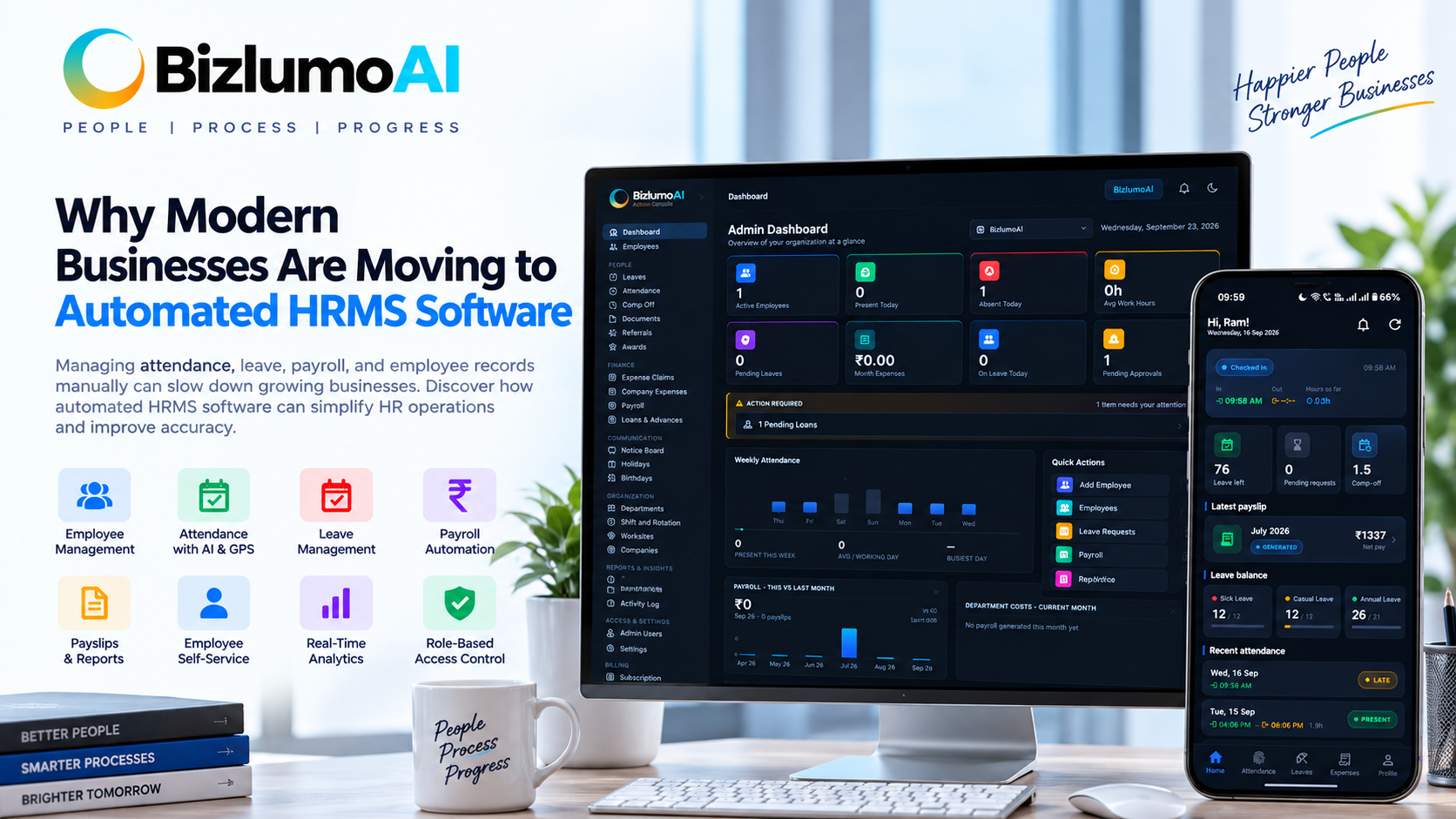
Managing employees is one of the most important responsibilities of any growing business. But as the number of employees increases, HR operations can quickly become difficult to manage.
Attendance records, leave requests, payroll calculations, employee documents, reports, and daily HR activities often end up being handled through spreadsheets, registers, WhatsApp messages, and multiple disconnected tools.
This is where an HRMS (Human Resource Management System) can make a significant difference.
What Is an HRMS?
An HRMS is software designed to centralize and automate everyday human resource operations.
Instead of maintaining employee information across different files and systems, businesses can manage important HR processes from a single platform.
A modern HRMS can help businesses manage:
- Employee records
- Attendance
- Leave management
- Payroll
- Payslips
- Employee self-service
- HR reports
- Departments and designations
- Role-based access
- Location-based attendance
- Employee communication
The objective is simple: reduce repetitive administrative work and give businesses better control over their workforce.
Why Manual HR Management Becomes Difficult
Manual HR processes may work when a company has only a few employees.
But as the organization grows, the complexity grows with it.
For example, an HR team may have to:
- Collect attendance data.
- Verify late arrivals and early departures.
- Track leave balances.
- Calculate working days.
- Prepare payroll.
- Generate payslips.
- Maintain employee records.
- Prepare monthly reports.
- Respond to employee queries.
- Correct errors across multiple spreadsheets.
A single mistake in attendance can potentially affect payroll.
A missing leave entry can create confusion.
And searching through multiple files for employee information can consume valuable time.
Automation Changes the HR Workflow
Modern HR software connects different HR processes into a centralized workflow.
Instead of managing each process separately, businesses can create a connected flow:
Attendance → Working Days → Leave → Payroll → Payslip → Reports
This reduces repetitive data entry and gives HR teams a more structured way to manage employee information.
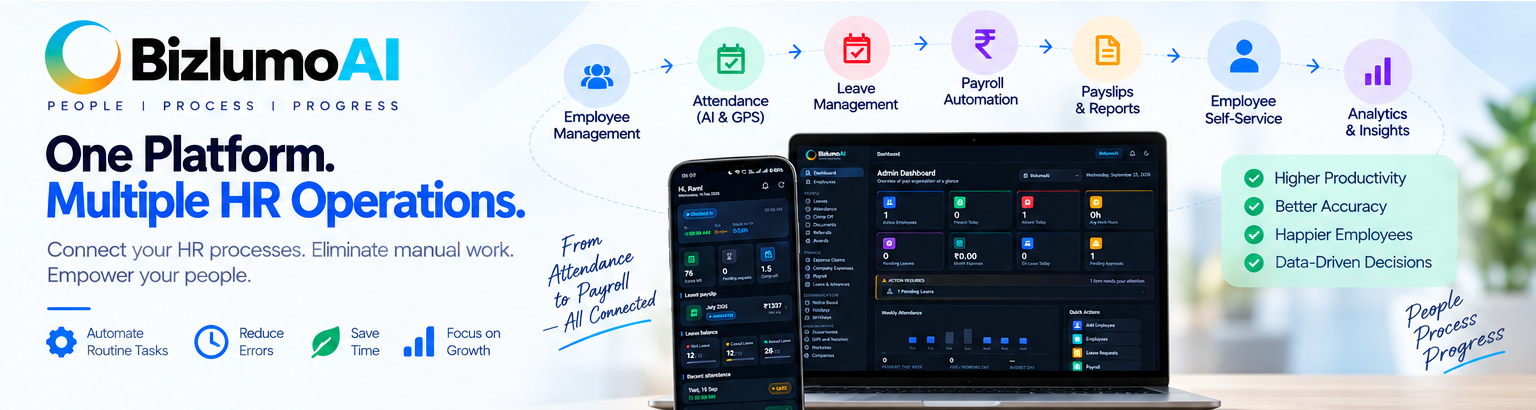
One Platform. Multiple HR Operations.
An automated HRMS can bring several everyday HR functions together:
- Employee Management
- AI & GPS Attendance
- Leave Management
- Payroll Automation
- Payslips & Reports
- Employee Self-Service
- Real-Time Analytics
- Role-Based Access Control
When these functions work together, HR teams can spend less time moving information between spreadsheets and more time focusing on people and business operations.
Smarter Attendance Management
Attendance is one of the most frequently used HR functions.
Modern HRMS platforms can support different attendance mechanisms depending on business requirements.
For example:
- AI-powered face recognition
- GPS-based attendance
- Geofencing
- Mobile attendance
- Web-based attendance
- Daily attendance reports
- Muster roll reports
For businesses with field employees or multiple locations, location-based attendance can provide additional visibility into where attendance is being recorded.
AI-based face recognition can also help reduce manual verification and streamline attendance recording.
Payroll Without the Spreadsheet Headache
Payroll is another area where accuracy matters.
HR teams often need to consider:
- Working days
- Present days
- Leave
- Late attendance
- Overtime
- Salary components
- Deductions
- Adjustments
- Payable salary
An HRMS can centralize this information and provide a structured payroll workflow.
Instead of rebuilding payroll calculations every month, businesses can maintain employee salary information and use attendance and leave data as part of the payroll process.
The result is a more consistent and traceable payroll operation.
Employee Self-Service
HR should not have to answer the same basic questions repeatedly.
An employee self-service system allows employees to access information and perform routine actions themselves.
Depending on the HRMS configuration, employees can:
- View attendance
- Apply for leave
- Check leave status
- Access payslips
- View personal information
- Track HR requests
This creates a better workflow for both employees and HR teams.
Real-Time HR Reports
Business decisions require reliable information.
An HRMS can bring important workforce information into centralized dashboards and reports.
Management can monitor areas such as:
- Employee headcount
- Attendance
- Absence
- Leave
- Payroll
- Department-wise workforce information
- Employee activity
Instead of spending hours preparing spreadsheets, HR teams can access structured reports whenever required.
Security and Role-Based Access
Employee information is sensitive business data.
A modern HRMS should therefore provide appropriate access controls.
Role-based access allows organizations to define what different users can view or manage.
For example:
Administrator → Full system access
HR Manager → Employee and HR operations
Manager → Relevant team information
Employee → Personal information and self-service functions
This helps organizations maintain better control over HR data.
Why Choose BizlumoAI HRMS?
BizlumoAI HRMS brings essential HR operations together in one platform.
It combines employee management, attendance, leave, payroll, reporting, and employee self-service into a centralized HR workflow.
Key capabilities include:
- AI-powered Face Recognition Attendance
- Anti-Spoofing Protection
- GPS-Based Attendance
- Geofencing
- Leave Management
- Payroll Automation
- Payslip Management
- Employee Self-Service
- Role-Based Access Control
- Real-Time Reports
- Mobile and Web Access
The platform is designed for businesses that want to move away from fragmented HR processes and adopt a more structured digital workflow.
HR Automation Is Not Just About Saving Time
The value of HR automation goes beyond reducing manual work.
A well-designed HRMS can help businesses create:
Better data → Better visibility → Better processes → Better decisions
When employee information, attendance, leave, and payroll are connected, HR teams spend less time maintaining data and more time focusing on people and business operations.
Is Your Business Ready for an HRMS?
You may benefit from an HRMS if your organization is experiencing:
- Increasing employee numbers
- Spreadsheet-based attendance
- Manual payroll calculations
- Frequent attendance disputes
- Multiple office locations
- Field employees
- Repetitive HR administration
- Difficulty generating HR reports
- Employee requests being handled manually
You don't necessarily need a large HR department to start using HR technology.
Even growing businesses can benefit from introducing automation early and building their HR processes around a centralized system.
Start Building a More Efficient HR Workflow
HR technology is moving from being a luxury for large organizations to becoming an important operational tool for businesses of all sizes.
The right HRMS can help bring attendance, leave, payroll, employee records, and reporting into one connected system.
BizlumoAI HRMS is built to help businesses make that transition — from manual HR administration to a more automated and organized workforce management system.